
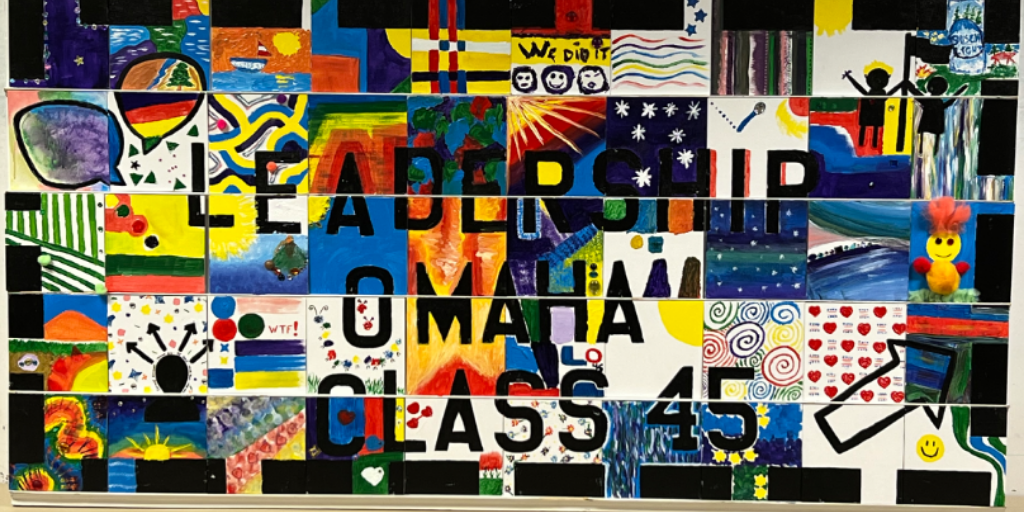
Leadership Omaha is one of the longest running professional development programs at the Greater Omaha Chamber. Since 1978, participants have immersed themselves in a 10-month learning experience focused on molding them into more effective community leaders.
This year, we’re getting a look inside. We’ll follow Matt Wenz, Head of Mulhall’s Landscape, as he takes this 10-month journey.
April
Justice
Our justice system is complex, and a single day is insufficient to understand its intricacies fully. One day is enough to scratch the surface. During our day, we heard various perspectives, but there were some, including the victim and law enforcement perspectives, that we did not have time to hear. I hope to share my perspective on the day and how the experience increased my awareness. An awareness of the problems with our current justice system, but also the opportunities that lie within.
We began the day being processed into the Nebraska Correctional Youth Facility (NCYF). We placed our cell phones, watches, belts, and jackets in lockers before being searched and entering the sally port. The gates closed behind us, and we were escorted across the yard to the school building. Our day was kicked off by LO Alum Nick Juliano, who gave us an overview of RADIUS, a non-profit organization focusing on restoring relationships between youth, families, and their communities. Nick also introduced the juvenile justice system as a whole in Douglas County.
The next perspective we heard was the inside perspective of Loretta Wells, the warden of NCYF. I was struck by Warden Wells’ approach to the culture of NCYF, it was evident she was very passionate about her work and cared deeply about the residents. This also seemed true of the entire staff, from the correctional officers to the teachers. A guided facility tour led by her staff gave us an inside look at the facility and the NCYF culture. The NCYF facility is unique. It is smaller than the other Nebraska prisons, and many correctional officers mentioned that they know all the residents by name. There was true care for the individuals incarcerated at NCYF, emphasizing rehabilitation.
Additionally, we got the unique opportunity to hear from multiple residents at NCYF, which was one of the most powerful moments of the day. The testimonies came from three young men and a more experienced individual who is a positive influencer and role model in the facility. The group spoke about their dreams for the future, what reforms they would like to see within the juvenile justice system, and what landed them within the system.
We then had the opportunity to hear from the government perspective hearing from a panel that included:
- Honorable Vernon Daniels, Separate Juvenile Court of Douglas County
- Kim Hawekotte, Juvenile Justice Services, Douglas County
- Mary Visek, Juvenile Probation, Douglas County
The panel gave insight into where our juvenile justice system has been in the past, where we are currently, and where they see it progressing. Each shared that the juvenile justice system is rehabilitative, not punitive. The principle guiding juvenile justice reform in Douglas County is “Beneath every behavior is a feeling. And beneath every feeling is a need. And when we meet that need rather than focus on the behavior, we begin to deal with the cause, not the symptom”. The panel left me both overwhelmed with how broken the system was but also optimistic about the progress already underway on the long road ahead of us.
We were processed from the facility and headed to lunch at the Kitchen Table. After lunch, we headed to the Justice Center, where we were guided on a tour. While there has been some controversy surrounding the Justice Center, we were able to hear a different perspective. The architect spoke about all the effort that went into the trauma-informed design and integrating those principles into the building. The Justice Center provides a centralized location for all juvenile justice services, making the system easier for parents to navigate. Children will no longer need to be shackled and paraded from their holding cells to the courtroom; instead, they will be transported via secure hallways directly to the courtroom. Additionally, it features abundant natural light, welcoming seating areas, and individual conference rooms for families to use. We wrapped up the day hearing from a local non-profit, RISE, which works to break the generational cycles of incarceration through various in-prison and out-of-prison programming.
It was a packed day, but one unexpected interaction stands out above the others. Pre-COVID, I had the opportunity to be a guest facilitator with RISE in their in-prison program at Omaha Correctional Center (OCC) on Monday evenings. One of the other facilitators, MJ, was a program graduate and one of the incarcerated individuals who gave back and helped facilitate the class for new participants. MJ has a powerful and calming presence. He’s a great mentor. He is a great listener. He is compassionate, knows when tough love is in order, and has the skill to deliver a hard message with poise and care. He is someone I would consider a friend.
I had not seen MJ since March 2020, but as we were on our tour of the housing unit at NCYF, I saw his friendly and familiar face through a cell window. It was like seeing a friend from college who I hadn’t seen in three years. We had a brief catch-up through the cell door. MJ is one of the older individuals who are serving their time at NCYF to be a positive influence on the youth. I remember many OCC class members saying that MJ was why they were in RISE’s class and that MJ was why they were getting back on the right track. I do not doubt that MJ will continue to impact many lives within NCYF. But there is one thing that sticks with me. My visits to prison are brief. I always get to go back home. MJ will never get to leave.
March
Government
It had been a couple of months since we’d last seen each other, and this seminar was a welcome reunion for our class. Our day kicked off at the civic center, where we engaged in a two-hour government simulation. We were divided into two cities and given various roles. I was the Parks and Recreation Director, and I channeled my inner Ron Swanson for the simulation.
A few things became apparent during the two-hour simulation: Many competing priorities and limited resources. Much deliberation was necessary to make the best possible decisions with the information provided to us. Many parties were involved, each with different opinions, and sometimes it felt like people would be unhappy no matter what we did. We had to work creatively as a team to find solutions the majority could get behind.
After a quick lunch at Doozy’s, we dove into a poverty simulation at Baird Holm. For many individuals and families, poverty is a harsh reality. For others, it’s unknown and misunderstood. Unless one has lived it, it isn’t easy to understand. The poverty simulation attempted to bridge the gap between misconception and understanding. In the simulation, I played the role of a 26-year-old male recently released from jail and still on probation. I lived at the homeless shelter with my girlfriend and an infant daughter. We faced many difficult decisions, including pawning our belongings to pay for bus fares or buying food over the clothing. It constantly felt like we only had terrible options, and the cycle repeated itself.
Two pieces from the simulation stood out to me:
- First, the facilitator asked us who was in a better position at the end of our simulated month than at the beginning, and most of us raised our hands. She pushed us further — were we really in a better position? What would it be like to do it for another month? I sat and reflected. While myself, my girlfriend, our infant was out of the homeless shelter and into stable housing, there weren’t any opportunities for me to make more money at work, and my girlfriend couldn’t get a job. One slight misstep or crisis, and we would be right back where we started.
- Second, the stress of the simulation was high, and it would pale in comparison to living in poverty daily. After the exercise, I could get back to my privileged life and retreat to comfort. The weight of the cycle of poverty became apparent. We felt there was no path to a more stable and secure life. It felt like the cards were stacked against us, and the system consisted of just enough handouts to keep us hopeful, but it would never be enough to break out of poverty.
The simulations served as a powerful reminder of the daily struggles that many individuals and families face. They emphasized the importance of empathy and understanding in creating a more just and equitable society. These simulations allowed us to gain new perspectives and a greater understanding of the complexity and nuance involved in daily issues facing our community.
January
Health & Human Services
We were greeted with another snowy morning — jokes of having the “coldest class ever” and “snowiest class ever” emerged. Our late start kicked off at the NorthStar Foundation for a panel on addressing poverty in Omaha. We heard from great organizations: NorthStar Foundation, Together, CHI, and Omaha Bridges Out of Poverty. All are working to address the various ways that Poverty impacts our city. Poverty takes many forms, but there is one common thread, it is a cycle that is extremely hard to break. Hearing the various presentations left me both hopeful and somber. Hopeful because of the great work in our community that is already happening, but also acknowledging how much further we have to go.
After lunch and a tour of NorthStar’s wonderful facility, we headed over to the Heart Ministry Center. There we had a chance to tour the property and see firsthand the various programs offered on-site. It was apparent that the phrase at the Heart Ministry Center, Dignity for All, is more than just a phrase. It is a way of life and an energy that ruminates throughout the center. We then wrapped up the day by hearing from Jeanee Weiss, from Children’s Hospital. She shared information on Nebraska’s youth mental health crisis, and what is being done to address it.
Reflecting on the day, I was struck by Mark’s testimony, which he shared with our group during our time at the Heart Ministry Center. He had a lasting message and a powerful challenge for the group, to live our truth. We heard about many different works happening in our city to address poverty, and when asked what to do about it, he challenged us to live our truth. No one can answer that question for us, we have to answer it for ourselves.
What are we going to do to tell the story of our day, craft the community in which we want to live, or live a life of impact? That is up to us.
December
Economic Development
Snow coated the pavement throughout the day as we spent our morning at the Village Empowerment Center, dispersed for lunch at local businesses, and wrapped up our day at WP Engine in the Ashton Building. The day offered an overview of economic development in Omaha, focusing on North Omaha, South Omaha, and Downtown Omaha.
Willie Barney, Founder and President of the Empowerment Network, kicked off the day by providing us with an overview of the various services offered at the Village Empowerment Center. He walked us through how the organization started with a group of concerned community members with a common goal, forging ahead with the group they had, refusing to wait for everyone. Today, that small group of concerned community members has grown into a nationally recognized network that is strengthening our community and reversing historical decisions that have left broad cross-sections of our community disenfranchised.
We then had the privilege of hearing from Dr. Cheryl Ingram, Nancy Williams, and Candice Price about their experiences as business owners. Each of them spoke about the joys, but also the struggles, of being a business owner, specifically the additional pressure and adversity faced as minority business owners.
The rest of the day was filled with learning about many exciting projects and developments in Omaha’s future:
- LB1024 Capital Projects Fund: Funding for projects with the goals of fostering desirable transformation, fundamental change, and long-lasting economic growth in the communities of North and South Omaha.
- Omaha Streetcar: A fixed-rail electric streetcar to run from 42nd and Farnam to 10th and Harney.
- Millwork Commons: A community of innovative people and enterprises.
- Builders District: A mixed-use development in the urban core.
- Omaha Community Foundation: Strengthening our community through powerful partnerships, building connections between people, ideas, and funding.
The day left me excited and optimistic for Omaha’s future, and equally a sense of responsibility and the challenge to be an active part of helping create the city we want to live in. During lunch, we split into groups of seven and went out to local restaurants for lunch. Four of the seven groups all went to Ahmad’s, where Ahmad happened to be working alone. Anna recognized an opportunity to step up and she was quickly pouring water glasses for the group. She was then joined by Sarah and many more as a small group of LO45 members worked alongside Ahmad to cook, plate, and serve the group, and even another table of complete strangers. It is surely a lunch that our group will remember forever and a true testament to the power of one person, Anna, leading the way to create a community that we are proud to call home.
Willie Barney left us with the message of “It’s Possible,” which is the best way to summarize the day. With a small group of committed individuals, aligned in vision and acting with intention, anything is possible.
November
Inclusivity
We began our seminar with a warm welcome to QLI’s campus. For many of us, it was our first time visiting. The opening session was hosted by Inclusive Communities, exploring the diversity of our network as well as the role implicit bias has had in shaping our network. The introspective activity was a reflective start to a day diving deeper into inclusivity and intentionality, calling us to take a candid look into our own lives, the people we spend time with, where are we in our comfort zones, and ask where our fears are holding us back from learning and growth.
Next, we had the privilege to hear the lived experiences of different members of the QLI community. Each story was unique, but the common thread was that of vulnerability, intentionality, and true partnership. There was not a dry eye in the house hearing these testimonies. It is hard to place, but there was a beautiful aura that surrounded us during our morning at QLI. Our tour guides mentioned that life is just different inside the gates, and it was a true testament to the power of intentionality, where people are encouraged to bring their best selves into an incredible environment of healing.
In the afternoon we ventured over to Tri Faith Initiative, where a mosque, synagogue, and church all sit on the same campus. After a quick game of ultimate rock paper scissors, we were led through an overview of the religious landscape of the US prior to taking a deeper dive into Islam with a tour from the Imam.
I believe when you experience something truly special, there are no words that can touch the emotional impact the experience had on oneself. It is hard to summarize the day in words, to find a quote that represents a piece of the day’s experience, or a picture that can convey the emotion – they simply just don’t do the day justice. For a small snippet into our day, here is a look into one of many touching stories that create that special aura at QLI.
It was a powerful seminar visiting organizations born out of concerned community members and a commitment to make a difference. For myself, the day fueled a series of internal reflections: why is diversity valuable; for whom are we creating more accessible and inclusive environment; what changes, both mentally and tangibly, are necessary to enact our visions for an inclusive community; and where in my life can I be challenged and criticized to learn and grow?
When it comes down to it, my biggest takeaway is continuing to ask myself: how am I living my life leading with intentionality and vulnerability.
October
City Environment
The brisk October air greeted us as we waited for the ORBT bus like kids awaiting a school bus. All bundled up, the entire group headed east to Downtown. For many of us, this was our first ORBT ride and was a welcomed new experience. Riding the bus allowed us the freedom to have conversations, and to watch as the built environment transformed around us on our journey. We disembarked on 10th and Douglas, strolled through the Gene Leahy Mall and made our way to KANEKO where we spent the morning learning about arts, culture, and creative spacemaking!
When we think of spacemaking within our community, many questions come to mind. What do we want out of our city? What do we need to feel culturally enhanced and whole? How are we creating space for more voices, new spaces, and new perspectives? What does inclusion look like when everyone has a different experience in a space? Our lineup of speakers offered insights into these questions, but we were again left with more questions than answers. Questions that prompted the sharing of our unique experiences with our neighbors, and listening and learning from their experiences. It also left us with a desire to try and find how to utilize our diverse perspectives to grow and amplify the voices of others.
After a morning of hearing from various creatives in our community, we ate some lunch, enjoyed the art around KANEKO, and took a quick tour of the Omaha Mobile Stage. Next, we embarked on a community tour of North Omaha, stopping at the Union for Contemporary Art before heading to South Omaha. As we traveled the streets as tourists in our own backyard, we learned more about Omaha’s history, heard stories, and got snapshots of rich culture sprinkled throughout our city. With a new eye for creative spacemaking, murals were brighter, business fronts livelier and history richer. Each of us leaving with a new or renewed appreciation for the various spaces in our city and a list of new restaurants and businesses to try.
As I reflect on the seminar and creative spacemaking in our community, one section of Richard Florida’s “Rise of the Creative Class” stands out:
More and more businesses understand that ethos and are making the adaptations necessary to attract and retain creative class employees—everything from relaxed dress codes, flexible schedules, and new work rules in the office to hiring recruiters who throw Frisbees. Most civic leaders, however, have failed to understand that what is true for corporations is also true for cities and regions: Places that succeed in attracting and retaining creative class people prosper; those that fail don’t.
September
Opening Retreat
The two-day opening retreat absolutely flew by, and a part of me felt like I was a kid back at summer camp. There was the initial excitement and nervousness as the retreat began, and everyone started getting to know each other.
But this retreat carried a different tone than other weekend retreats or networking events. There was an authenticity and openness to each and every conversation. Through our introductions, nighttime skits, and discussions throughout the day, everyone was truly leaning into the experience, and strangers started to become friends. As the retreat progressed, the normal walls and barriers we as humans tend to construct were lowered, creating an amazing space for sharing, creativity, and authenticity.
Day two was all about discovery of self and intimate connection. We learned about our thinking preferences, talked about Omaha today and tomorrow, and our small group pairings were revealed.
Our small groups – mere acquaintances just hours before – became tight-knit little communities as we shared six-minute life stories, with details normally reserved for those closest to us with years of trust. The activities and exercises progressed, and we continued to learn more about each other and our community. Ultimately, I left the retreat excited and eager for the journey ahead.
Now, reflecting on the opening retreat, I keep coming back to two things: vulnerability and questions.
Vulnerability, a la Brené Brown in her TED talk, The Power of Vulnerability. Vulnerability as a necessary means to connection, belonging, and joy. This retreat was such a beautiful experience of complete strangers electing to be a part of something more – tied together by a shared passion we have yet to discover and an openness to journey as a group to see where the path leads.
And questions:
- What will the next 10 months hold?
- What does the future of Omaha look like?
- What impact can I have on my community?
- Where are my talents and interests best utilized?
- How can I learn from others along this journey?
- Will it all be worth it?
The retreat provided more questions than answers. And perhaps that’s the point: sitting in the discomfort, uncertainty, and imperfection, and being okay with it. If the answers were easy, societal problems and inequity wouldn’t exist, and we certainly wouldn’t need programs like Leadership Omaha to bring together diverse cross-sections of our community to learn more and discuss them.
So at the onset of Class 45’s journey, I have in the forefront of my mind an excerpt from Letters to a Young Poet, by Rainer Maria Rilke:
“…I would like to beg you, dear Sir, as well as I can, to have patience with everything unresolved in your heart and to try to love the questions themselves as if they were locked rooms or books written in a very foreign language. Don’t search for the answers, which could not be given to you now, because you would not be able to live them. And the point is, to live everything. Live the questions now. Perhaps then, someday far in the future, you will gradually, without even noticing it, live your way into the answer.”
May
Poverty, Privilege and Legacy
Within a span of 10 days, we have seen tragedies in Buffalo and in southern Texas that have rocked our nation and have deeply impacted our own circle of family and friends. This collective grief, on top of the ongoing effects of the pandemic and inflation, have been a tragic and timely backdrop to this blog.
Our day began at Project Harmony, a local nonprofit aimed at counteracting and preventing child abuse. Each of us went through a poverty simulation, immersing ourselves into real-world roles as a family with or without government assistance, with or without interactions with law enforcement, with or without two adult caregivers and more. Poverty in this instance assumes that a person may have limited access to transportation, housing, food and education. Knowing that some classmates have first-hand experience of poverty or are in poverty now, this exercise had an element of privilege attached to it: Some of us could imitate hardship and then step back into our comfortable lives once the exercise ended.
I left the simulation even more frustrated with our system. My role was an unemployed parent with a family member with a disability, a working partner, a child in school and one vehicle. We had a mortgage, approached an eviction, pawned appliances – all while I attempted to receive additional government assistance. I visited one government agency three different days, only to be told we didn’t qualify for assistance, while unable to secure a job. Those feelings of frustration were amplified throughout the day, along with layers of accountability and responsibility for myself, my classmates and our community. Everything we reflected upon and discussed showed how each observation compounded over and over – into a spiral.
That morning we also heard from staff with the Nebraska Department of Health and Human Services, Omaha Police Department and others focusing on children’s services and early intervention.
As in other seminars, a common theme emerged: one scenario, one decision can have legacy-forming impacts.
Into the afternoon.
We are at the Food Bank for the Heartland and heard about affordable housing with Front Porch Investments, Nebraska Appleseed, Canopy South and Together. The day ended with a discussion on food insecurity with the food bank’s president and chief executive officer.
My classmates and I are now a week from graduation. In front of us is a predictable and probing question: Where do we go from here? Bearing witness to the reality of our neighbors’ world and their communities isn’t something that stops at commencement – it can’t.
And I think that’s the takeaway for Leadership Omaha and other local leaders – at least it is for me. Our decisions – or lack of – have legacy-forming impacts. That responsibility is immense. We must open our eyes, our ears, our minds and ultimately our hearts and hands to those in our communities.
When we truly become “others-focused,” the courage to do something worth lasting is right around the corner.
April
Justice: Conversations on the Inside
No smartphones. No watches. No electronic devices of any kind.
That was the order to our Leadership Omaha group as we filed through a metal detector and were individually searched at the Nebraska Correctional Youth Facility.
I realized I was walking into something very personal. And emotional. I have family and friends who have experienced negative encounters with law enforcement, and here we were – in the interior of “the system.” This minimum-to-maximum custody facility houses male juvenile offenders from adolescence to age 21. Capacity at the building in northeast Omaha is nearly 70 residents.
Staff began ushering us toward classrooms, where we could see instructors teaching basic educational objectives. Class is mandatory for those who don’t have a high school diploma or their GED and who are under 18. My only wish at that point was that they had a chance to learn what they wanted, what they found interesting. Teens need variety and options to keep their interest and their enthusiasm for learning alive.
We then met with four incarcerated youth, all individuals of color. Their crimes landed them sentences anywhere from five to 30 years. As they shared their stories and feelings, my mind raced to the sobering truth: How quickly one bad decision can affect the course of your entire life.
I kept thinking about the previous Leadership Omaha experience, where we learned how trauma has an impact on learning. Teachers and other educators can guide young people to avoid incarceration. But many kids start with some pretty big disadvantages. Several north Omaha neighborhoods generate some of the highest incarceration rates in the United States, according to a local media outlet’s analysis of Harvard University data. That’s heart-breaking. Two of those we visited with had lost their fathers and had no male role models. What if they had a teacher who was really invested in them? One young man shared that he was from a rural area. “None of this should have happened,” he said. “I should have listened to my parents.” It made me have a real appreciation for my mother and father, who are still very much a part of my life.
As a person of color, knowing the stats are stacked against me and others is unsettling. One of our Leadership Omaha classmates told me of his feelings afterwards: “We are centuries away from solving the problems within our justice system. Many Band-Aids over large wounds.”
Walking out, I picked up my phone, the dozens of emails I had missed and my normal life on the outside. But part of me remained on the inside, back with the young people who, while they had hurt others, were also hurting. I had a renewed sense of making things better for other young people who I’m going to meet. I want to make sure Omaha is a city that is good for youth. And my task now is to make sure it’s not just a feeling. I want to carry and see it through. Whether the system changes or not.
March
Long Live the Library, and Economic Development
As luck would have it, I’m in our downtown library on St. Patrick’s Day. Our Leadership Omaha class is here to learn about economic development from members of the Greater Omaha Chamber.
Sitting in my professional green attire, I am immediately taken back to my childhood in elementary school in Franklin, Tennessee, where I volunteered at our local library. As a small girl with wide eyes toward all things reading, my job was to put checked-in books back in order on the right shelves. It was one of my favorite “jobs” of all time.
My fascination with literature never stopped, and today it led me to get my Omaha Public Library card – a physical, hold-in-your-hand honest-to-goodness library card. (Later in the week, after our Leadership Omaha event, I took my four-year-old daughter to get her card, as well.)
Digital subscriptions, digital media, digital technology. It’s all great, but I still like the feel of a book, with its cover and binding and (sometimes) even the smell of good ink. But, I digress.
In listening to this morning’s speakers, several things stood out:
- Development must be geographically inclusive; it’s not just about what we can do in north Omaha or in any other one location.
- As we adjust to what pandemic-normal looks like, businesses will still need office space, but they must think deeply about how to use it differently. The days of 100% occupancy might be over, but new creative working arrangements are just beginning.
- “The library is a social safety net.” The disadvantaged in our communities need a library and their outreach programs to feel welcomed and appreciated.
After the library – and after I got my card – the last half of the day was spent at Carson Wealth, a financial advisory firm. There, we heard from three businesspeople of color. More insights:
- “Omaha is a one phone-call city.” The things we need should be only one phone call away, but what happens if you don’t have the phone number? That’s where relationships come in. Connectivity is the key in business, in communication, in all things.
- Eight out of 10 Black-owned businesses fail in their first 18 months.
- Despite the disadvantages of these three individuals, their success largely has been due to their “stubbornness and unwillingness to quit.”
To sum up the day, my take-aways were that you should always have at least one green outfit in case you have to go out on St. Patrick’s Day. And at least three things are very important: connection, networking and access. And finally, library cards are still in vogue, and they will be as long as my daughter and I keep checking out our favorite books.
February
The Sum Total – Negative or Positive
“You are the sum total of everything you’ve ever seen, heard, eaten, smelled, been told, forgot – it’s all there. Everything influences each of us, and because of that I try to make sure that my experiences are positive.”
Maya Angelou penned those words, and I was recently reminded of how true they are when attending the latest Leadership Omaha event.
Our class met on a recent Thursday, first at NorthStar Foundation and then at Metro Community College. We were introduced to the concept of Adverse Childhood Experiences, or ACE. Each of us, we learned, come into adulthood with varying degrees of negative events from our “growing-up” years. In discussing the process of working through those pain points, the terms trauma sensitive and trauma informed were also mentioned. With the former, we acknowledge adverse events and adjust to them. With the latter, we may need medical intervention or customized therapy to overcome trauma.
I learned that 46% of students come to school with at least one ACE. Some come with three or four significant adverse experiences – which can include physical, verbal or sexual abuse and physical or emotional neglect. Other ACEs can be having an alcoholic parent, a family member in jail, divorced parents or a relative with a diagnosed mental illness. Throw in racism, bullying or even surviving a severe accident and you can see how ACEs can stack up.
The original ACE study performed by the Centers for Disease Control and Prevention found that two thirds of participants had at least one ACE and 87% of those had more than one.
Then we learned about PCEs, or positive childhood experiences.
It sounds simple but adding PCEs is important. The additional presentations from local public school officials reiterated how much our role models in Omaha can make either a negative or positive difference – the responsibility is huge. And living in this pandemic as a parent of a pre-schooler, my interest in how our local schools are responding to the next generation only increased.
One of my takeaways that day was the importance of staff self-care. One of our presenters quoted local community leader and philanthropist, the late Dick Holland, who said, “You are an asset too precious to waste.” That message goes out to those of us who lead – whether you’re a teacher, a parent, an elected official or a supervisor. In my own role as a communications director, I am responsible for a team of about a dozen individuals – they are too precious to waste. They work hard at sharing important information to those inside and outside of our company, day in and day out. It made me think even more about my role in providing a positive environment in which they can thrive, do their best work, and have space to think and rest and recover from the daily grind. This world of COVID has crept into home life and work life and the stress is real.
We are the sum total of everything we experience. I’m grateful for Leadership Omaha for giving me an opportunity to see that once again. It’s time to gather some more positive experiences.
February
You Ran Out of Money on Day 18
The title of this month’s Leadership Omaha blog is derived from a pre-work exercise we did called “Spent.” Spent is an online game about the challenges brought forth by poverty; throughout the simulation, players must make a series of difficult decisions necessary to live one month on very little money, often having to choose between equally disagreeable options. It was an illuminating and important precursor to this month’s themes: education and human services.
We were joined by several community leaders from various non-profit organizations who work to advocate for the children and families in our city. Each provided their own unique insight into how our local education and human services organizations coordinate to create innovative and timely local responses that can have a real impact on those who need it most.
Of all the discussion we had that day (and there were many), the piece of advice that stuck with me most came from our OPS Superintendent, Dr. Cheryl Logan (listen to an interview). Dr. Logan has navigated our city’s largest school district through what may be the most unnavigable year. She has a lot of experience leading, often having to make difficult and sometimes unpopular decisions.
So, when she gives leadership advice, we listen. And she left us with this piece of advice that I feel will surely stick with me as I move forward in my own leadership journey: “It’s amazing what you can accomplish if you do not care who gets the credit.” Often attributed to President Harry S. Truman, the quote feels prescient in that it calls us do the work of bettering our community, not because we want fame or notoriety, but because it’s the right thing to do. Regardless of where we work, how much money we make, what we do for a living, we all have the power to make our city better – to help ensure that fewer families have to choose between equally disagreeable options in order to survive.
March
Ahoma: The City that Never Coasts
The quickest way to give someone like myself (a right-brained, creative writing, English major-type) a permanently furrowed brow and elevated heart rate is to simply invoke two words: budget simulation. This month’s Leadership Omaha seminar promised to give “insight into the workings of city government.” What could go wrong?
We broke out into two teams, each forming the government of a fictional city called Ahamo – with its own mayor, group of department heads, city council members, lobbyists and reporters. Our governments were given one task: work together to prepare and approve a balanced budget.
It feels like an impossible task to establish a budget that makes everyone happy. And, of course, it is an impossible task. As in real life, everyone in our simulation had their own priorities and agendas. The obligations, demands and priorities of our fictional government and its actors were often at odds with one with another. Some of us were more successful than others in getting what we wanted. Even though there were moments when we struggled, we worked to find a compromise wherever we could.
As the crease in my brow began to disappear and my heart rate slowed, I came to see the real value in the exercise. I had a new appreciation and empathy for the massive undertaking our local elected officials and leaders encounter when preparing Omaha’s annual operating budget. Turns out, you can learn a lot about a government by reviewing its budget and even more by preparing the budget yourself. Lesson learned.
April
We Don’t Coast, We Lead
This month, we were excited to hear from a group of Leadership Omaha alumni about their experience with the program and how it impacted the trajectory of their civic, professional and personal lives. Several alumni have gone on to lead non-profits or dig deeper into their volunteer work with local organizations. It was heartening to hear how their experience in Leadership Omaha not only inspired them to become more active within the community, but also to see how the connections they made in the program continue to grow and flourish.
Throughout these conversations, it was immediately evident that Leadership Omaha has historically created a strong sense of comradery between its classmates. An overarching theme that emerged from our small group break out room discussions was something I’m sure many people (in Leadership Omaha or otherwise) can relate to: we miss being able to get to know each other in in-person, face-to-face settings.
Class 43’s all-virtual Leadership Omaha experience is wholly unique – with a few exceptions, many of us have never met each other #IRL. If there was one key takeaway from our last session, it’s that as a group, we have a strong desire to build on the foundations of our virtual engagement and find ways to deepen our connections with one another through intentional, in-person get togethers. Lucky for us, there are plenty of leaders in Leadership Omaha Class 43 and before we had even concluded our session, we had our first in-person, lunch scheduled.
I can’t wait to meet all these people again for the first time.
May
Playing Tourists in Our Own City
This month’s “City Environment” session marked the second-to-last time Class 43 will meet before we officially graduate from Leadership Omaha next month. Hard to believe that we’ll soon be marking the end of our time in the program. Like so many experiences in the middle of the COVID pandemic, the time has gone inexplicably fast and slow all at once.
This session (which would have been our first session had it happened in the before times) involved meeting, in person (yes, in person) as small groups to visit a set of locations across the city. There are so many dedicated people working incredibly hard to make Omaha a city that’s diverse, accessible and inclusive in revolutionary ways. The fact that the process of meeting face-to-face also allowed Class 43 to get an inside peek at places like the Benson Theatre, Seventy Five North, El Museo Latino and Historic 10th Street only made our May session experience that much better. We got to put on our tourist hats for a bit and explore the amazing work being done in and around our city—and, at long last, we got to do it together.
June
A Love Letter to Class 43
We did it, Class 43 – we officially graduated from Leadership Omaha!
Last week, we marked the final official session of our time together. As we say farewell to our time in Leadership Omaha, I want to tell each and every one of you how grateful I am to have spent this time with you.
Was it a normal Leadership Omaha experience? Not in the slightest.
Do I feel a little wistful thinking about the bonding we missed out on by having our entire program over Zoom? Sometimes I do.
Will I still miss seeing you each month? Absolutely, I will.
To witness the digital camaraderie manifest as real-life fellowship at our LO graduation (where some of us met in-person for the first time), only solidifies how important a program like this is. We started Leadership Omaha as 49 strangers, looking to make the best of a situation none of us could have imagined; we ended Leadership Omaha as a community of people united by a shared responsibility to take what we’ve learned and move our city forward. It’s an experience I would whole-heartedly recommend to anyone who asks.
Many LO alumni will say their class is the “best class ever,” and I’m sure, year after year, that ends up being true. None but us, however, can say they are the best quarantine class ever. Thank you for being a part of this unique Leadership Omaha journey – for sharing your ideas and being vulnerable, for asking challenging questions and being willing to have difficult conversations, for being open and honest and going along for the ride, odd as that ride may have been.
I envision great things from Class 43, and I could not be prouder to have been a part of it with you.
Matt has a natural ability to bring people together toward a common purpose. In 2021, after leaving the world of public accounting, Matt joined the Mulhall’s team as a Controller and quickly discovered a new-found passion for beautiful landscapes and the work involved to create and maintain them. Now, as Head of Mulhall’s Landscape, he’s able to use his business background, a love for collaboration, and his appreciation for the natural world to amplify the impact of the Mulhall’s Landscape team here in Omaha and the surrounding community. Matt and his wife Annie love spending time with family and friends, being outside and exploring the Omaha community.
Leadership Omaha gives community leaders a chance to shine. If you have a vision for the future of Greater Omaha, then this is the program for you.